Start with what you want, then do your homework
The best way to choose a massage therapist in Seattle is pretty straightforward. Decide what you want from the session, read reviews for what clients actually say, and ask a question before you book.
That sounds obvious. But it’s easy to choose a massage the way you’d choose a parking spot. Whoever shows up first in the search. Whoever has an opening tonight. Whoever is the cheapest.
Choosing a massage therapist deserves much more thought than that. It’s expensive. It’s personal. You’re trusting someone with your body for an hour or more, and you’re hoping to walk out feeling better than you walked in. A little research up front is the difference between a session you forget and a therapist you keep for years.
So before you look at anyone, ask yourself one question. What do I want to be different when I get off the table? Maybe it’s a stiff neck you want to turn freely again. Maybe you just want to feel calm and cared for after a hard month. Both are good answers, but they may point you toward very different therapists.
Read the reviews, not the stars
Star ratings tell you very little. A 4.7 and a 4.9 look different on a screen, but they don’t tell you whether a therapist is right for you. The words in the reviews do.
When you read reviews, look for at least two things.
- The outcome you want. If you’re after relief, look for people describing the result in their own words. “I could turn my head again.” “My lower back finally let go.”
- The feeling you want. If you’re after rest, look for how people say they felt. Calm. Cared for. Not rushed. Listened to.
Here’s a real example from our own reviews. Kimberly J. loved that their therapist was “engagingly conversational in alert moments.” Artemis L. praised the opposite and appreciated that there was “very little chit chat.” Both gave five stars, and they wanted opposite things. If you only looked at the stars, you’d never know which experience was right for you.
When the same outcome or feeling shows up in review after review, that’s a pattern, and patterns are what you’re looking for. One glowing review can be luck. Ten reviews that say the same specific thing usually aren’t.
A few more things worth noticing:
- Which therapists get mentioned by name, and what people say about each one.
- Whether reviewers describe the therapist adjusting to them, or just doing a routine.
- How the business responds when a review is critical. Defensive or thoughtful tells you something.
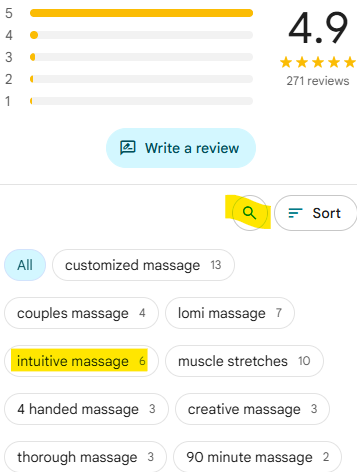
Here’s how I do that, using our Fremont location as the example. I search for Massage Reimagined Fremont on Google Maps and click the Reviews tab. Under the star summary, there’s a list of popular keywords for this practice, and “intuitive massage” sticks out to me.
If I click the button, I see a handful of reviews that mention intuitive massage, but that’s not good enough for me because I’m really interested in intuitive massage. So I don’t stop there, because keyword chips only capture exact matches.
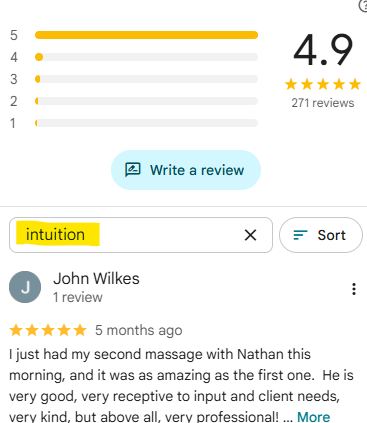
Instead, I click on the spyglass and type in the word “intuitive,” which brings up about 20 more reviews that I can look at to learn more about how people feel about the intuitive nature of this practice’s work.
However, I’m really interested in this aspect of their work, so I go a little further. I search for the word “intuition,” and a few new reviews pop up that I didn’t see in the other search. Between the two searches, I get a much fuller picture of what past clients have to say about this practice and their intuitive massage. One tip: every word you type has to appear in the review, and partial words don’t count. Typing “intuitive intuition” only shows the rare review that uses both words, and “intui” finds nothing. So search each word on its own.

PS: You can try the same thing on Yelp. But when you find the review that really piques your curiosity, click the reviewer’s name and message them. You can’t do this on Google. They may not answer, but chances are, if they’re a Yelper, they’ll want to tell you about their experience.
Send them a question before you book
If a practice looks promising, click through to their site and send them a question. It takes two minutes, and the answer tells you a lot.
Ask about the thing you actually care about. For example:
- “I sit at a desk all day, and my neck and shoulders are always tight. Who on your team would you recommend?”
- “I like firm pressure, but I tense up when it hurts. How do your therapists handle that?”
- “It’s my first massage. What should I book?”
Then pay attention to how they answer. Did they respond to your situation, or send a stock reply? Did they recommend a specific therapist and say why? Did they ask you anything back?
Also ask about their intake process, and whether they’ll send you their intake form before you book. The form shows you what a practice wants to know about you before you get on the table, and it tells you a lot about what to expect. Do they ask about positions that are hard for you to lie in? Sensitive skin, or areas you’d like them to avoid? Scents you love or can’t stand? How stress shows up in your body? A thorough form usually means a practice that plans your session around you. A form that’s just your name and a signature line tells you something too.
A practice that listens to your email is more likely to listen to you when you are on their table.
Look at how the practice runs
A great therapist in a rushed system will still give you a rushed massage. So it’s worth checking a few things about how a practice works, not just who works there. Most of these you can find on a website or ask in that first email.
| What to check | Why it matters |
|---|---|
| Is a 60-minute massage 60 minutes on the table? | Some places count undressing, intake, and checkout as part of the hour. That can quietly cost you ten minutes or more. |
| How many massages does a therapist give in a day? | Massage is physical work. A therapist on their seventh session of the day is not the same as one on their third. |
| Is there time between appointments? | Without a buffer, sessions start late or end early, and you can feel the hurry. |
| Is the price the price? | Watch for add-ons and upsells. You shouldn’t have to negotiate your way to a good massage. |
| Do they ask what you want before they start? | A good intake conversation is how a therapist learns what “better” means to you. |
| Can you change your mind mid-session? | Pressure, focus areas, talking or not talking. You should be able to say so, and it should change. |
None of these require a fancy spa. They’re choices a practice makes about how it treats both clients and therapists.
Check the license
In Washington, anyone practicing massage needs a massage therapist credential from the state Department of Health. It takes about a minute to check.
The Department of Health’s Provider Credential Search lets you look up a therapist by name. It shows whether the license is active, when it expires, and any disciplinary actions on record.
A license doesn’t make someone a great therapist. It does tell you they’ve met the state’s training and exam requirements and are accountable to a licensing board. That’s the floor, not the ceiling.
How we approach this at Massage Reimagined
I built Massage Reimagined around the same things I’d tell anyone to look for. Sixty minutes means sixty minutes on the table. Our therapists usually give no more than three or four massages a day. We leave at least a full half-hour buffer between appointments, so nobody waits outside your door. The price is a flat rate based on time only, with no upsells. Our intake form is four pages long, and it is constantly being updated as we learn more things that we find helpful to know before your massage. You can read it here before you book.
If you’re still not sure who to book, our Find Your Therapist page describes each therapist’s style. Or send us a question, the same way I’d suggest you do anywhere else. For a first visit, we recommend 90 minutes, which gives you time to talk about what you want and still have a full session.
We have three Seattle locations:
- Fremont, 4464 Fremont Ave N
- Magnolia, 3150 W Government Way, Suite 2
- Lower Queen Anne, 311 W Republican St, 2nd floor
You can see current prices or book online. And whatever you decide, read the reviews, ask your questions, and choose someone who listens.
Frequently asked questions
How do I find a good massage therapist in Seattle?
Decide what you want from the session first. Then read reviews for descriptions of that outcome or feeling, check the therapist’s Washington license, and send the practice a question before booking.
Are star ratings a good way to choose a massage therapist?
Not on their own. Many established practices have similar ratings. The written reviews tell you far more about what a session with a specific therapist is actually like.
What should I ask a massage practice before booking?
Ask about your specific goal, such as tight shoulders or wanting to relax, and who they’d recommend for it. Also ask whether session times are full time on the table, whether prices include everything, and whether they’ll share their intake form.
How do I check if a massage therapist is licensed in Washington?
Use the Washington State Department of Health’s Provider Credential Search. It shows license status, expiration, and any disciplinary actions.
How long should my first massage be?
At Massage Reimagined, we recommend 90 minutes for a first visit. It leaves time to talk through what you want without cutting into the massage itself.
Can I search Google reviews for a specific word?
Yes. Open the business in Google Maps, go to the Reviews tab, and click the search icon. Type a word like “intuitive” or “deep tissue” to see every review that mentions it. Every word you type has to appear in the review, so search related words like “intuitive” and “intuition” one at a time. It’s often more useful than the star rating.